
KASHMIR INDIA - THE PROMISED LAND?
Most readers will probably be surprised about some very strong evidence revealing the Promised Land Jesus spoke about was Kashmir, India. But why would Jesus select that place?
It's almost commonly accepted now that ten lost Jewish tribes found their way to Afghanistan and Kashmir, India. And Kashmir was particularly friendly toward the Jewish people. Wasn't Christ the Messiah? Was not his direct mission from God/Krishna to take care of the Jewish people? What better place, at that time, than peaceful Kashmir! Of course, kali-yuga has changed much of the peace there. Remember that we are speaking of how the India/n people would have treated them a good 2,000 years ago, thus at a time when there was significantly less progression of kali-yuga!
According the the Bible, Matthew 10: 5-6, Jesus did indeed instruct his disciples to: "Go not into the way of the Gentiles, and into any city of the Samaritans enter ye not: But go rather to the lost sheep of the house of Israel.” Many now believe these 'lost sheep" Christ was speaking of were not 'fallen' disciples, etc., but they were actually "lost" -- The Ten Lost Jewish tribes that had been scattered away.
Thus in Jerusalem, Christ's disciples met together to follow through on their guru's instruction and preach his message to the remaining Jewish tribes, dividing the countries up between themselves. Thomas specifically was assigned to India. That he went there is an accepted fact even by modern day Christians. In India where he is known to have been (various places), his presence and writings are still recognized amongst the people.
Next, there were quite a few pure devotees or great saints of similar religious teachings at that time who now have 'samadhi's' in Kashmir, India. For example, Moses, Aaron, Solomon and Jesus -- yes, they all have samadhi's there. IIt'ss a fact. You can visit some of them to this day. Thus, more evidence.
While the Hindu custom is cremation -- not burial (and I use the word 'Hindu' loosely because Hinduism is not Krishna consciousness, but for simplicity we will leave it at that), when it comes to great saints, they are never cremated! Only the common man or woman is cremated, but yogi's, saints and pure devotees of the Lord are not. It is understood that such great souls go into a heightened and enlightened state of consciousness before passing over to the spiritual word. This consciousness is called "samadhi." Thus, their bodies are kept here on earth in what some may call a tomb, but we call (transcendental) samadhi. In this way everyone can continue to reap benefit from them. (What mercy!) We have all heard about miracles when someone touched a sacred garment worn by a saint, their 'tomb' (samadhi!), prayed in their 'presence,' or something else. And when the miracle is not obvious or external, it is often a miracle of the soul.
With that said... God specifically ordered Moses to journey opposite and past Jordan, to go East, beyond the Euphrates/Jordan River. Upon arriving, God made Moses see it was the Promise Land. "Get thee up unto the top of Pisgah and lift up thine eyes, westward and northward and southward and eastward and behold it with thine eyes, for thou shalt not go over this Jordan."
It appears that Moses was standing on the East bank of the Jordan/Euphrates River because at that time the Eastern border of Palestine touched the Jordan River. He than proceeded to go in the direction of the East, avoiding Palestine completely. Thus Palestine was NOT the Promise Land.
In Deuteronomy 34 of the Bible, it gives reference to five places of the tomb/samadhi of Moses. All of those five descriptions point to the valley in Kashmir.
Deuteronomy 44 of Chapter IV on, refers to the Land of Promise God will grant them after their deliverance from captivity. There are three places mentioned. Beth-peor, Heshbon and Pisgah. Mount Nebo is also mentioned in another place and in conjunction with Beth-peor.
Many theologins and scholars alike deny the exact place of the current Promise Land based on no physical evidence. That's because they have gone into this examination with the preconceived idea it was to be found within Palestine. They are looking in all the wrong places! The Promise Land was in India.
BRIEFLY:
Beth-peor - translated as house or place that opens. Previously the Jhelum River of Kashmir was called Behat. Similarly, Bandipur, in Tehsil Sopore Handwara /Kashmir, use to be called Behatpoor. It is "the place of gaping or opening." From this place the Kashmir valley opens out; the river Jhelum passes into the Wullar Lake. It certainly appears that Beth-peor is really Behatpoor /Bandipur.
Heshbon - means pools, or streams in valley's. IInteerestingly enough, approximately twelve miles south-west of Behatpoor/Bandipur, Kashmir is a village called Hashba, well-known for pools of fish. A nearby area called Auth Wattu (meaning the 8 ways) -- Maqam-i-Musa -- is reputed as the "Pplace of Moses."
Pisgah - Approx 3 mi. NE of Hashba. Generic or bassic name for a mountain range called Abarim. (Deu 32.49).
Mount Nebo/Baal Nabu - meaning lofty place, the single-peaked Mount Abarim, thus Mount Abarim. It is near Bethpeor, Kashmir (approx. 8 mi NW of it). Mount Abarim is said to be the same as Pisgah of Kashmir. And the samadhi of Moses can be found at Mount Nebo, Kashmir.
So many different places, though with similar names, all closely correlating with the land of Kashmir. What a coincidence! Coincidence? I doubt it. :-)
Nor is Palestine a good fit regarding the description of the Promised Land. Deuteronomy, 4: 41 - towards the sun-rising, Deuteronomy, 11:11 - a land of hills and valleys that drinketh water of the rain of heaven, Deuteronomy, 11:14 - rains shall fall in this land in due season, Deuteronomy, 4:49 - land will extend even up to the sea of the plain, under the springs of Pisgah, Deuteronomy, 11:21 - "heaven on earth." -- This does not sound like the desert or climate of Palestine, but it clearly fits the climate of Kashmir, India.
Add to that, the prophecy of Isaiah who foretold that after suffering captivity, the Children of Israel should go to a land of beautiful streams and springs, and it would be theirs -- He did not foretell that they would go to some dry, desert-like place. Considering the Lost Ten Tribes never returned to Palestine, Isaiah could not have been referring to that as the Holy Land. Whereas, it appears he was referring to had Kashmir, as it is a very good description of the land of Kashmir. Irrigation is from natural sources in Kashmir, springs or streams, with its many valleys. Incidentally, Baal, in the language of Kashmiri means "a spring." And it turned out that Kashmir India was the place where the Lost Tribes went, and stayed, and are.
There is actually much more evidence I could include here to prove Kashmir India was the originally intended Promised Land all along, but time and writing space limit me. Nor is it the full topic of this web page. Eventually I may return to add more. However, one very significant point can be added, and that is science. Not as the final or most important proof, simply as additional.
JEWISH DNA IN INDIA? Let us stop for a moment to look at this. New findings revealed that there is something very specific about Jewish DNA, therefore testing can reveal if there has been any connection to Jewish ancestry. A technique is used which examines the Y-chromosome. This chromosome is only passed from father to son. What is quite unique is that most of the strand doesn’t exchange DNA with a partner chromosome. And it is stacked in a specific order to that of previous Jewish ancestors. I am no scientists, but this is sound. Testing was performed on the Bene Israel Jews of Alibag India, which gave significant validation to stories by the India/n's that Jews traveled to, and settled down in, Kashmir India.
Here is yet something which may be of further interest, which predates Christ but may help us to understand. Long ago two floods destroyed the Indus civilization (in India), and blame was put upon artisans, farmers and those who lived in the city - all known as the Yadava's or Yadu's. Thus, they ran from their homeland country, scattering themselves to the Middle East and elsewhere. In time they became known as the "Jew's." Of course, alterations from the original spiritual teachings began to appear, where it eventually became an entirely different doctrine. Thus, Krishna sent Jesus to return them to their homeland.
On his way to Kashmir, Christ walked through a valley known as "Yusmarg," or "the Meadow of Jesus." This area was populated by the Yadu race- thus descendents of the ten lots tribes of Israel. They supported themselves by herds and flocks. A nearby ancient route was used by merchants between Afghanistan and Kashmir for trade. Next, moving East, Jesus stopped to rest in an area now called "Aishmuqan" the "Resting Place of Isa" (Aish=Isa, muqan=resting place). As time went on and the era progressed, Aishmuqan has become Mohammedan.
Regarding the Yadu connection, we need to hear what Prabhupada has to say about it:
"Because there is some similarity of the word Jew and Yadu so some historian or scholar, so called, created this notion. I have read it also in some paper. But even it is true, we have nothing to do with it. Lord Krishna killed his own dynasty under His personal supervision. So certainly Krishna didn't like the idea that future dynasties would be able to identify having Krishna's blood. Krishna has no material blood; neither He is different from His body. The example is given that Malayan sandalwood is famous as grown in Malaya but the fact is that sandalwood can grow anywhere. Nowadays in Malaya there are only rubber trees but still in the market the sandalwood is known as Malayan sandalwood. Similarly a family may become famous for Krishna taking birth in that family but Krishna is independent and can appear anywhere and everywhere, where His devotees are. ~ Letter to Nayanabhirama, London, Aug 22, 71"
One the one hand, some who are of Jewish heritage may like to see a connection to Krishna, and so I present it. On the other, we understand the pure Yadu dynasty was returned to Godhead. The more recent Yadu's were selling animals. While we can't say for certain it was for slaughter, not many folks bought pet birds back then. Thus we see this is not the same Divine Dynasy, because Krishna took them with Him and out of this material world. It is good to take it up a notch and realize we are not our bodies but spirit soul, therefore everyone is connected to Krishna anyhow. So here Prabhupada is giving us the highest knowledge, that even if Yadu and Jew have what may appear to be some blood connection, it does not extend to Krishna, as He does not have material blood. Only soul connection is what anyone can have with the Lord. Genealogy has been mentioned here simply to give an idea how people of various heritages got to where they are currently residing for the sole purpose of revealing how Jesus Christ, satktyavesa avatar, ended up in India, preached there, and has his samadhi there. However, God has no favorites. Simply when there is a need, Krishna loves all His children equally and therefore either descends Himself or sends a bona fide representative to save them. This can be seen by the many saints, pure devotees and incarnations of God in various (bona fide) religions, to ultimately bring them back to Him.
So getting back on course, step number one: After God had Jesus return the children of Israel to a land more favorable to "detailed" knowledge of Who He is, then Christ could, slowly, patiently, elevate them in this way. For students of Bhagavad-gita we have learned that long ago all land was originally connected as one, called Bharata-varsa or India. Initially, we were all from the Holy Land. In time, for various reasons, it broke apart and separated. Sound strange? Ever notice how the world map looks like it would fit together like a puzzle? That's because it does. Anyway, we were all once devotees of Krishna and have just forgotten our eternal nature due to being covered over by maya (material energy) for a very long time.
One of the most impressive document I found, because it reveals Christ's secret spiritual understandings ("I have yet many things to say unto you, but you can not bear them now" John 16:12), his specific plan for his disciples gradual enlightenment, as well as his personal belief of how God is to be worshipped, would be the Bhavisya Purana of India. It is written in the most ancient language on the planet, Sanskrit. Many say it is the original language as well as the one spoken in the spiritual world.
JESUS MENTIONED IN THE BHAVISYA PURANA OF INDIA?

First I would like to point out concerns I heard regarding human beings tampering with this particular Purana. First, I sadly say that I would not put it past some to do so. However, whenever I have read various modified scripture, it almost always has to do with changing the teachings to please some person or persons, either in the church or government (such as the Bible), and not about names or dates.
India respects other religions and pure devotees from any path, so it is even more unlikely tampering would be about people they do not consider their primary saint, or who was there, or how they lived, etc., because this simply goes against their personal belief system, one of mutual religious respect. Particularly the teachings of Lord Jesus Christ, since most India/n's revere him anyway.
To have a problem with saints and great souls from other religions is more of a Western difficulty, often perceiving Eastern, or any other path, teachers, guru's, saints, etc., a threat to fundamental Christian beliefs. However, even when the British tried to overtake India as well as convert the people of India to Christianity, though the majority of Hindu's did not convert, most added a picture of Lord Jesus on their home altars. :-)
Short version on the idea that this may have been added to the Bhavishya Purana? From that perspective: Only after the rise of Christianity - but with the exception of prediction, there would also be appreciation and respect. In other words, only if a person exhibited symptoms of a great rishi or saint, would anyone enter them into the book.
Ultimately it would not matter if someone were to choose to disbelieve the Bhavisya Purana as accurate in this regard, since there is plenty of other documented evidence proving that Jesus traveled to many lands which are not recorded within the Bible, but he settled down and lived in India and continuing his preaching there. Further evidence was mentioned about his worship of Lord Jagannatha/Krishna in the Jagannatha Puri temple, India (letter from devotee on blog, etc.) what to speak of much information under the title, "Documents Of Christ In India," above.
With that said, here is what has been found of Jesus Christ within the ancient scripture known as Bhavisya Purana. Most don't know Sanskrit so don't worry, just skip it and scroll down to the English. I simply included the Sanskrit to show this is ancient text. For those who know even a little, I've indicated a few words to help catch your eye.
[Shalivahan, ruler over the Aryans, grandson of Vikramaditya, occupied the throne of his father. He vanquished the attacking hordes of Chinese, Parthians, Scythians and Bactrians. He drew a border between the Arians and the Mleacha (meat eaters), and ordered the latter to withdraw to the other side of India.]
ekadaa tu shakadhisho
himatungari samaayayau
hunadeshasya madhye vai
giristhan purusam shubhano
dadarsha balaram raajaa
"One day, Shalivahan, the chief of the Sakyas, went into the Himalayas. There, in the middle of the Land of the Hun, the powerful king saw an auspicious man who was situated on a mountain. His complexion was fair and he wore white garments."[NOTE: A) His color was fair in comparison. B) Hun is Hunadesh, near Manasa / Kailash Mountain in W. Tibet; also known as Lasadakh, part of the Kushan empire.]
ko bharam niti tam praaha[NOTE: Jesus refers to himself as the son of God which is suggestive that, tho he surely is one, there could be others. How does one come to that conclusion? First, it does not minimize Christ's position in the least. Next, if someone has a brother but that brother is not with them and they meet a new person, upon inquiry of who they are, they may reply 'I am so-and-so's son.' This does not mean so-and-so can only have one son. God is surely able to create more than one perfect son.]
su hovacha mudanvitah
iishaa purtagm maam viddhi
kumaarigarbha sambhavam"The king asked, 'Who are you sir?' 'You should know that I am Isha Putra, the Son of God,' he replied blissfully, 'and am born of a virgin.'
mleccha dharmasya vaktaram
satyavata paraayanam
iti srutva nrpa praaha
dharmah ko bhavato matah"I am the expounder of the religion of the Mlecchas (meat-eaters) and I strictly adhere to the Absolute Truth.' Hearing this the king enquired, 'What are religious principles according to your opinion?'
shruto vaaca maharaja
prapte satyasya amkshaye
nirmaaryaade mlechadesh
mahiso 'ham samaagatah"Hearing this questions of Salivahara, Isha putra said, 'O king, I came from a foreign land where there are no rules or regulations and and evil knows no bounds. When the destruction of truth occurred, I, Masiha the prophet, came to the country of degraded people. Through me the sinners and delinquents suffered, and I also suffered at their hands. Finding that fearful irreligious condition of the barbarians spreading from Mleccha-Desha, I have taken to prophethood'.
mlecchasa sthaapito dharmo[NOTE: Christ again uses the word "Isa" here. Whether it is spelled Issa or Isa, it is the same. We should notice he first makes a distinction between that of Isa (God), and the Isa-Masih or one who came to preach about God. As mentioned on my other web pages below, Isa is a name for Krishna that means the "Supreme Being" or "Supreme God." However, Isa das and Isa-Messiah both denote "servant" of God. Different language, same meaning.
mayaa tacchrnu bhuupate
maanasam nirmalam krtva
malam dehe subhaasbhamnaiganam apamasthaya
japeta nirmalam param
nyayena satyavacasaa
manasyai kena manavahdhyayena pujayedisham
suurya-mandala-samsthitam
acaloyam prabhuh sakshat-
athaa suuryacalah sada"'Please hear O king which religious principles I have established among the mlecchas. The living entity is subject to good and bad contaminations. The mind should be purified and the body by taking recourse of proper conduct and performance of japa, chant the holy names to attain the highest purity. Just as the immovable sun attracts, from all directions, the elements of all living beings, God as firm as the sun, Who is fixed and all-attractive, attracts the hearts of all living creatures. Thus by following rules, speaking truthful words, justice, mental harmony, unity of spirit and meditation, O descendant of Manu, in the center of that light one will find their way to Isa, and should serve and worship Him as that immoveable Lord'."
isha muurtirt-dradi praptaa
nityashuddha sivamkari
ishamasihah iti ca
mama nama pratishthitam"Having placed the eternally pure, auspicious form of Isa, the Supreme Lord and giver of happiness, forever within my heart, O protector of the earth planet, I preached these principles through the Mlecchas' own faith, and thus my name became the Isa-Masih.'
[NOTE: Christ refers to the "Form" (murti) of God as Isa, so it again indicates Jesus believed in Deity worship, most likely as long as such worship was performed by sincere, honest, qualified priests/brahmana's.]
iti shrutra sa bhuupale
natraa tam mlecchapujaam
sthaapayaamaasa tam tutra
mlecchasthaane hi daarune"After hearing these words and paying obeisances to that person who is worshipped by the mlecca's, the king humbly requested him to stay there in that most miserable land of Mlecchas."
svaraajyam praaptavaan raajaaThus ends the second chapter entitled, "The Age Of Salivahara" of the story of Kali Yuga of the Caturyuga Khanda also called pratisarga-parva of the wonderful Bhavishya Maha Purana, 3191 Kaukikia Era or 115 A.D, ~ Srila Vyasa dev - literary incarnation of Lord Krishna.
hayamedhan cikirat
rajyam krtva sa sasthyabdam
svarga lokamu paayayau"King Salivahara, after leaving his kingdom performed an asvamedha yajna and after ruling for sixty years, went to heaven. Now please hear what happened when the king went to svargaloka."
(Bhavishya Purana 19:20-33.)
The question often arises, "If Jesus was pure, why did he put so much attention on healing the material body or even on 'material' truth or 'material' justice, etc?" To this, the answer is above in Christ's own words, but to sum it up: it was a step by step process.
First he taught them to be clean in body which next lead to soul. Then there were different rules, like thou shalt not kill and the other commandments, keeping them on the human being platform (as the 4 regulative principles by Srila Prabhupada are to keep us on the human being level). Next, Jesus taught them prayer/japa and to think often of God or meditation. If all this was followed, his disciples could eventually understand the concept of God as light (the impersonal brahmajyoti). From there, they would find "in the center" of that light: Isa/ Krishna. (Reminds me of the story of the Four Kumaras who were impersonalists but it lead them to ultimately discover the higher Personal form of Krishna.) Then Christ's disciples would finally be able to, both in heart (Paramatma) and through the all attractive Deity (form) "Isa" or Lord Shri Krishna - find happiness that never leaves but stays within forever, thus spiritual happiness. Therefore, through his process, Christ's disciples could become elevated from material status of sudras to the highest transcendental position of Vaisnava!
However, did Christ even go to India? Well, in the popular book published in 1983 titled: "Jesus Lived in India" the researcher by the name of Holger Kersten set out to show that Jesus did indeed live in India. This book gives details of his travels there during his so-called lost or hidden years from the Bible [or when the Bible does not know where he was or what he was doing at a certain age], as well as the crucifixion, and more. It offers documentation that Jesus lived in two ashrams within India and studied Vedic scripture.
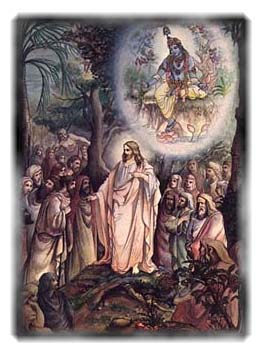
THE 'REAL' PASSING OF JESUS THE CHRIST
Summerized from the book, "Kamal-ud-Din vas Tman-un-Ni'mat fi Asbat-ul-Din" (pp. 357-8), Muslim research about the life and passing Yuz Asaf (Isa thus Jesus) in Kashmir India, gives a few details how Christ really passed over.
Jesus knew he was leaving, as he sent for his disciple Thomas (Ba 'bat) when he felt death approaching. Jesus expressed his last wish was that his work would be continued, and that a tomb (samadhi?!) should be raised over him at the exact spot where he expired. Thomas did as he asked. Jesus was buried with his feet pointing West, and his head to the East.
There are a couple of important points here. One is that the average person, in most cases, do not know when they shall die. Whereas great saints, yogi's, satyktyavesa avatara's and various types of pure devotees most certainly do! Jesus, as son of God, was able to prepare because of his exalted spiritual position allowed him that special awareness.
Next, Jesus prepared to leave in the direction many yogi's and great saints, but especially pure devotees of India prepare to leave. That is, they make sure their head is facing East.
The guru/spiritual teacher who is about to depart, then instruct their disciples to place a Samadhi over them. Not that they are carried away into some dingy cave but instead, the Samadhi is to be over the exact spot they depart from this material world. The reason? Mercy. They know it becomes a Holy place and that people in the future can go there and STILL benefit from them! In this way they can continue to save souls.
That Jesus also did these many things, impressed me.
The author of this book, whose name I wanted to make sure to include but being long, thought it best to put it here for those who are not familiar with the language, myself included. Al-Shaikh-us-Sadiq Abi Ja'far Muhammad ibn'Ali ibn Hasain ibn Musa ibn Baibuyah al-Qummi. He was a great oriental historian and writer also know as Shaikh Al-Sa'id-us. He realized the journey's of Yuz Asaf (Jesus) and made sure to put them onto paper, first publishing -1882.
By the way, the author of that book believes Jesus lived to 100 plus years of age, and his passing was of natural causes.
"Regarding the Christian's Trinity, I believe it is called God, the Holy Ghost, and the son. Person in Krishna Consciousness accepts this by the name Visnu, Paramatma, and Jiva. God is a Person, the holy spirit or the supersoul is a person, and the living entity is also a person. Also, Mary is the representation of the energy of God. Either as internal energy Radharani or as external energy Durga, the energy of Godhead can be considered the mother of the living entities. But there is no clash between the Bible and the Vedas, simply some people formulate their personal ideas and cause quarrellings." Srila Prabhupada Letter to Sivananda das, NY April 19, 1968
"There are many examples in history of devotees of the Lord who risked their lives for the spreading of God Consciousness. The favorite example is Lord Jesus Christ. He was crucified by the nondevotees but he sacrificed his life for spreading God Consciousness. Of course, it would be superficial to understand that he was killed." Srila Prabhupada, B. Gita 11.55
"When great yogis are in samadhi, even when their bodies are buried and their skin, marrow, blood and so on have all been eaten, if only their bones remain they can exist in a transcendental position. Very recently an archaeologist published findings indicating that Lord Christ, after being buried, was exhumed and that he then went to Kashmir. There have been many actual examples of yogis' being buried in trance and exhumed alive and in good condition several hours later. A yogi can keep himself alive in a transcendental state even if buried not only for many days but for many years." Srimad Bhagavatam, 7.3.18 P
Devotee: Prabhupäda? Does Lord Jesus Christ appear in the spiritual sky with the body he manifested on the earth?
Prabhupäda: Yes. Otherwise how there can be resurrection? Ordinary body cannot be resurrected. He appeared in his spiritual body, certainly. Jesus Christ told, if I remember, that “Lord, excuse these persons,” who were crucifying him. Is it not? He knew that “These rascals, they are killing me, but... They are offending certainly. So they do not know that I cannot be killed, but they are thinking that they are killing.” You see? But that was offensive, therefore he begged Lord to be excused because God cannot excuse to the offenders of the devotee. He can excuse one who is offender to God, but if somebody is offender to the devotee, God never excuses. Therefore he prayed for them. That is devotee’s qualification. He prays for everyone, even of his enemy. And he could not be killed. That he knew. But those rascals, they thought they were killing Jesus Christ.
That’s all. All right. If there is no question, chant Hare Krsna. (end) Bg lecture 4.1-6 LA 1-3-69
"It is said that Lord Jesus Christ, when twelve years old, was shocked to see the Jews sacrificing birds and animals in the synagogues and that he therefore rejected the Jewish system of religion and started the religious system of Christianity, adhering to the Old Testament commandment "Thou shalt not kill." ~ Srimad Bhagavatam, 7.15.10 P
"And then there is saktyavesa-avatara. Saktyavesa-avatara, they are counted just like Lord Buddha, Jesus Christ. They are counted amongst the saktyavesavataras. They are also incarnation of saktyavesavatara, powerful." Srila Prabhupada lecture, CC Madhya 20.172, NY Dec 14, 1966
Prabhupäda: Body of Christ is not ordinary body. That is spiritual body. Krsna, as Krsna says in the Bhagavad-gétä, yadä yadä hi dharmasya glänir bhavati bhärata [Bg. 4.7], pariträëäya sädhünäà vinäçäya ca duñkåtäm, dharma-saàsthäpanärthäya yuge yuge sambhavämi ätma-mäyayä [Bg. 4.8]. So this is a very subtle point. One has to understand that when God comes or God’s son comes or God’s representative comes, they do not accept a body like us. They have their spiritual body. SB lecture 7.6.1 June 10,68
Rukmini: Is there a Christ-loka?
Prabhupada: Yes. Why not? There are innumerable lokas. Why not Christ-loka? (break)
...jagad-anda-koti-In the effulgence, bodily effulgence of Govinda, just like the sunshine is effulgence of the sun planet, similarly, Govinda's planet, the original planet, which is called Goloka Vrndavana, that is the original effulgence, light. And when that light is distributed there are innumerable universes created. Just like within the sunlight there are innumerable planets. So in each and every planet there are different kinds of living entities, so why not a planet belonging to Christ? There is no doubt about it. There must be. (break) The Fifth Canto of Srimad-Bhagavatam, the description of different planets are there. (break) Question?" S.B. 7.9. 12-13, Montreal Canada, Aug 20,68
kotisv asesa-vasudhadi-vibhuti-bhinnam
tad brahma niskalam anantam asesa-bhutam
govindam adi-purusam tam aham bhajami
Revatinandana: I have a question. One of my prabhus told me that you once said that your Guru Maharaja said that Jesus Christ was a saktyavesavatara. Is that correct?
Prabhupada: Yes. Because he said it, it must be correct. Muhammad also, saktyavesavatara."
~ SP, SB 6.127-34, Lecture, Suat, Dec., 17, 1970
"So do not think that the Hindus, they have got disregard for Lord Buddha or for Lord Jesus Christ. No. They have all regard. Anyone who comes as representative of God, or as God, as powerful incarnation, they are all welcome. According to time, according to place, according to the audience, they may speak, speak something which is, which may be different from the Vedic conclusion, but they are accepted as powerful incarnations." ~ Srila Prabhupada lecture Sri Caitanya Caritamrta, Madhy lila 20.154-157, NY, Dec 7, 1977
".... Mohammed identified himself as a servant of the Supreme Lord. Thus whenever there is a discrepancy in our constitutional position, the Supreme Lord either comes Himself or sends His representative to inform us of the real position of the living entity. ~ Srila Prabhupada, On The Way To Krishna, Chapter 2
"In another place the gentleman quotes one book written by Prof. Charles Smith. The book's name is ``The Paradox of Jesus in the Gospels''. In this book it is admitted that all the statements in the Bible are not directly spoken by Jesus. Some of them are staged through the mouth of Jesus Christ; and specifically this passage: ``I am the way, the Truth and the light. No man comes unto the Father but by me.'' This gentleman admits that it is put into the mouth of Jesus because that is the literary convention of the author of the 4th Gospel. Such kinds of observations definitely suggests that there are many passages in the Gospel which are later on set up to be spoken by Lord Jesus Christ, but actually they were manufactured by different devotees. So far as our Bhagavad-gita is concerned, we do not find any such thing. Everywhere it is stated sri bhagavan uvaca: the Supreme Personality of Godhead said. And all the acaryas have accepted these words as they are spoken by the Lord. No authorized acharya has ever commented that it was put into the mouth of Krishna by Vyasadeva or Sanjaya or any other person." ~ Srila Prabhupada Letter to Satsvarupa -- Tittenhurst House, England 31 October, 1969
A devotee of Lord Jesus Christ is one who is strictly following the ten commandments. Now just like in the commandment "Thou shalt not kill" this is a moral instruction for the sinful man. Similarly Lord Buddha also emphasized ahimsa paramadharma "the highest religion is nonviolence." So these instructions are for the sinful men. When one is pious, instead of being sinful, he is promoted to the higher planetary systems like Janaloka, Mahaloka, or Tapaloka and they are above the planet Svargaloka. So persons who are cleansed of sinful life become eligible for spiritual life. From the instructions of Lord Jesus Christ we find that the stress is given to make men free from sinful life--such as "Thou shalt not kill" "Thou shalt not covet"--like that. Therefore the conclusion is that the devotees of Lord Jesus Christ are promoted to the heavenly planets which are within this material world." SP letter to Bhagavan, March 2, 1970
Revatinandana: "The ten offenses to avoid in chanting the maha-mantra. The first is blaspheming the Lord's devotee." Just read them?
Prabhupada: Yes.
Revatinandana: "Second, considering the Lord and other demigods on the same level."
Prabhupada: This is very important point, blaspheming the devotees. The Lord's devotee, in many countries, many places... Just like Lord Jesus Christ, he's also devotee of Lord. Muhammad, he's also devotee of Lord. So it is not that because we are Krsna conscious, we shall unnecessarily decry any other parts, any other devotee. It may be, according to time, place, and country, the method may be different, but anyone who is preaching devotion to God, he's a devotee of God. So he should never be blasphemed. Yes."
~ Srila Prabhupada Talk, Initiation Lecture and Ten offenses Lecture, LA, Ca., Dec 1, 1968
"To get out of this miserable condition, Sukadeva says, here it is, says, karunaya aha. Karunaya means "out of compassion." People are suffering. This is Vaisnava. Vaisnava takes so much trouble to speak to the rascals and dulls about God consciousness. Why? Out of compassion. They are very compassionate. "Oh, so many people are suffering for want of knowledge. Let me try to give them some knowledge." Karunaya. This is Vaisnava's qualification. He is very kind. Titiksavah karunikah. Titiksavah karunikah. Just like Lord Jesus Christ. He was being crucified. Still, he was saying, "My father, they do not know what they are doing." Is it not? He is so much compassionate that "These rascals do not know what they are doing, rascals. Still, I request You to forgive them." This is Vaisnava. Personally he is suffering, but he is still compassionate. There was an article recently, that Jesus Christ, although he was crucified, he did not die. Yes. He went to Kashmir. Some historical references are there. So actually, when he was representative of God, son of God, how these rascals could kill him? It was a show only."
~ Srila Prabhupada, Srimad Bhagavatam 1.2.3, Rome Italy, May 27, 74
"The Vedic civilization is... Therefore India was open to everyone: "Come on. Come here." Therefore they entered as friend, and they conquered. Because India was open. "Yes, you are guest. Come on. You learn here." Lord Jesus Christ also went there to learn.
~ Srila Prabhupada lecture, Srimad Bhagavatam 2.9.14, Melbourne, April 13, 72
There are many examples in history of devotees of the Lord risking their lives for the spreading of God consciousness. The favorite example is Lord Jesus Christ. He was crucified by the nondevotees, but he sacrificed his life for spreading God consciousness. Of course, it would be superficial to understand that he was killed. Similarly, in India also there are many examples, such as Thakura Haridasa. Why such risk? Because they wanted to spread Krsna consciousness, and it is difficult. A Krsna conscious person knows that if a man is suffering, it is due to his forgetfulness of his eternal relationship with Krsna. Therefore, the highest benefit one can render to human society is relieving one's neighbor from all material problems. In such a way, a pure devotee is engaged in the service of the Lord. Now, we can imagine how merciful Krsna is to those engaged in His service, risking everything for Him. Therefore it is certain that such persons must reach the supreme planet after leaving the body." BG 11.55 P
"It is a fact that the Lord Jesus Christ is present by His words. Krsna is also present by His words.
These personalities, either God or the son of God, who come from the transcendental world, keep their transcendental identities without being contaminated by the material world. That is their omnipotence. We are in the habit of saying that God is omnipotent. Omnipotence means that He is not different from His name, from His quality, from His pastimes, from His instruction. Therefore, the discussion of Bhagavad-gita is as good as discussion with Krsna Himself."
~ From Srila Prabhupada's 'Krishna the Resevoir of Pleasure'
"The sages of old age discovered it by spiritual culture that man's energy should be utilized only for spiritual realization. Not to speak of Lord Sri Krishna who spoke the philosophy of Bhagavad-gita near about 5000 years ago, we know that within 2000 years of human history no sages including Jesus Christ, prophet Mohammed, Lord Buddha, Acarya Sankara, Madhya, Ramanuja or even Lord Caitanya gave any importance to materialistic way of living. Material necessities were always subordinate to the spiritual realization."
~ Srila Prabhupada letter to Jawaharlar Nehru, Allahabad, Jan 20, 1952
"Prabhupada: The Lord says that the purpose of all Vedic instruction is to achieve the highest goal of life, back to Godhead. Any scripture of any country, not only of this Bhagavad-gita, but any scripture, they are aiming simply how to get us back to Godhead. That is the purpose. Take for any ex... Take for example any of the great religious reformers or acaryas of any country. In your country, Lord Jesus Christ or Lord Buddha. Of course, Lord Buddha, he advented himself in India, but later on his philosophy was broadcast all over Asia. Then Lord Krsna, or Hazrat Muhammad -- anyone take. Nobody will say that "You make your best plan in this material world and live peacefully. That is a common factor. There may be little difference according to country, climate and situation in the scriptural injunction, but the main principle--that we are not meant for this material world, we have our destination in the spiritual world--that is accepted by everyone." ~ Srila Prabhupada Lecture, BG 8.28-9.2, New York, Nov 21, 1966
"So prasanta. Prasanta vimanyavah. Without any anger. Vimanyavah. Suhrdah. These are the examples. Just see. Suhrdah. Su-hrda means one who is actually wanting your welfare. That is called suhrt. Just like father, mother. In spite of so many faults on the part of the son, still they are willing always, "How my sons will be happy." These are the examples of suhrdah. He's not ordinary friend. Ordinary friend, that is reciprocation: "If you do me, then I shall do to you. Otherwise not." But suhrdah means the other side does not do anything benefit, but one side is always willing. That is called suhrdah. Similarly, a mahatma, he is not well received. He is criticized, insulted, sometimes injured. Still, he wants Just like Lord Jesus Christ. He was so badly treated and still he was thinking, "Father, they do not know what they are doing. Please excuse." This is suhrdah. He is praying to God This is sadhu, mahatma. Suhrdah prasanta. Not that... In India there are examples like Haridasa Thakura, Prahlada Maharaja. And the Western countries also, Lord Jesus Christ, he is saktyavesa-avatara, God's son. And he tolerated so much. These are the examples of mahatma." ~ Srila Prabhupada lecture Srimad Bhagavatam 5.5.3, Vrndavana India, Oct 25, 76
"Lord Buddha had to introduce the religion of nonviolence by contradicting the Vedic sacrificial instructions. Actually, in the sacrifices the slaughtered animals were given a new life, but people without such powers were taking advantage of such Vedic rituals and unnecessarily killing poor animals. Therefore Lord Buddha had to deny the authority of the Vedas for the time being. One should not perform sacrifices that will induce reversed orders. It is better to stop such sacrifices." ~ S.B. 4. 19 36 Purport
"At a certain stage of human civilization when such material activities in the name of religion (as sacrificing animals in the name of yajna) were too much rampant, the Lord incarnated Himself as Buddha and decried the authority of the Vedas in order to stop animal sacrifice in the name of religion." SB 1.5.14 P
Prabhupada: "...So anyone who is speaking about God with authority--take for example Jesus Christ; he is speaking in the western world--you accept him. We Indians, we accept Caitanya or Ramanujacarya, Madhvacarya. That is the way. That is the way because these acaryas, these authorities, they are speaking about God. None of them speaking that "You become happy here," no, none of them. Either Christ or Caitanya or Mohammed, nobody has said. So according to the time, circumstances, position, either you follow any one of them as it suits you or, if you can make a comparative study, you follow the best one. So therefore, our conclusion is Krsna is the best. He is God. Christ is son of God. So we don't differ son of God and God. That is all right. But when the father is speaking personally, he is speaking what the son has spoken plus something because he is more experienced. So take the father and follow him. That's all. Mohammed says he is servant of God. Christ says he is son of God. And Krsna says, "I am God." So where is the difference? The son will say the same thing, the servant will say the same thing, and the father also will say the same thing. So theology means to know God and abide by His order. That is my understanding. And theology does not mean to make research who is God. That is theosophy. So if you are theologicians, then you must know what is God and abide by His order. What do you think, Dr. Judah?
Doctor Judah? Pardon?
Prabhupada: What do you think this proposition?
Dr. Judah: Yes, well, I think you're quite right. I think that it is... Certainly, in our day and age many of us don't really know God.
Prabhupada: Then he is not theologician. He is theosophist.
Dr. Judah: We know about God, but we do not know God. I would agree."
~ S.P. Garden Conversations with Professors, Chairman of the Religion Dept. of U.S.C., and Dr. Stillson Judah, and others - June 24, 1975, LA., Ca
(A devotee writes Srila Prabhupada and inquires the following.)
Question fourth: What Lord Jesus Christ says, that is the destination of his devotees. What Lord Jesus Christ says I do not know. If there is no description of the Kingdom of God, then we give that--cintamani prakara sadamasu . . . etc.
Question the fifth: If Mohammed as the servant of God and Lord Jesus Christ is the son of God, then where is the break of the disciplic succession. After all the disciplic succession is beginning from God, so how do you find that there is no disciplic succession? If the original tree has branches, twigs and leaves and they are in touch with the original tree, it is alright. The test is whether the line is in touch with the Supreme--that is all.
(Srila Prabhupada replies)
"Although Mohammed and Jesus Christ appeared in the Kali Yuga their instruction is as it is because the persons to whom they had to speak could not understand any more and they find it difficult to understand even that much." ~ SP Letter to Vrndavana Chandra, LA, CA., July 19, 1970
Prof. Regamay: But I am struck that, for instance, for us in the West the idea of personal God is strongly rooted in our consciousness.
Prabhupada: Yes. Lord Jesus Christ, he was Vaisnava. He directly gave you the idea of personal God. The personal God is the origin. Brahmeti paramatmeti bhagavan iti sabdyate. The... Just like, the same example: the sun god, the sun planet and sunshine, they are one. They are not different. But still, this is impersonal, that is localized, and within the sun globe, there is the sun god. So sun god is the origin of this light. Similarly, Krsna, the Supreme Personality of Godhead, He is the origin of everything. Aham sarvasya prabhavo mattah sarvam. That's the fact. But people with poor fund of knowledge they cannot understand it. Therefore stop... (break) ...light, that's all. So much. Just like Lord Buddha. He did not explain anything about God. He said, "Just obey me and stop this animal killing." Therefore this much sufficient for him, that's all. The lower class students, one plus two equal to three, two plus two..., that much mathematics, not higher mathematics. Higher mathematics is not possible to understand."
SP Room Conversations w/Prof. Regamay, Prof of Sanskrit at U. of Lausanne, June 4, 74, Geneva
Jesus: "I have yet many things to say unto you, but ye cannot bear them now." John 16:12
CONCLUSION

As devotees of Krishna, like anyone else, we want Jesus on our side. :) Whether our backgrounds were Christian or Jewish, or for that matter Muslim, Buddhist, Hindu, Sikh, or others, we too want Jesus to be a Vaisnava. I am no exception. Nevertheless, we also have to go by the facts. From everything I have read and studied thus far, I have no doubt that he was indeed a Vaisnava. (Even the Shroud has tilaka. See web page 1.)
I also believe he had a specific mission from Krishna to save the Jewish people and "gradually" elevate them. Jesus WAS, after all, the Messiah. Thus, he had to perform the duties that fulfilled the prophecies of the Messiah. He was to save the Jewish people or the children of Israel. (Though he would save anyone.) He also was to worship Krishna quietly within his heart, and later Lord Jagannatha in India.
Jesus was both: Messiah and Vaisnava.
One might say, he was a 'closet' Hare Krishna devotee. :-)
(Though it appears he revealed the highest knowledge of Krishna as the Supreme Personality of Godhead to the few who could accept it.)
What is sometimes missed about satktyavesavatar's, or from what I have seen so far, they do "not" appear in this world to preach directly about Krishna. They appear with a very specific mission of Krishna's. For example, Lord Buddha, a satktyavesavatar, was to destroy Holy Scripture due to the people abusing it. Mohammad, a satktyavesavatar, instructed against illicit sex, then elevated people through moral conduct and prayer. Therefore, we shouldn't assume because a satktyavesavatar did not speak directly of Krishna, that they were unaware He is God. Some readers may feel they'll never know cent per cent. That is all right, though so much evidence reveals that these great souls knew within their heart. Anyway, we can know the satktyavesavatar is on a very specific mission by Krishna of gradual elevation because that is what was needed.
Regarding Christ, a satktyavesavatar, his mission was that of the Messiah and savior of the Jews. He was to stop the sales of animals in the temples and meat eating of the people (as well as also giving instructions on illicit sex), then to give higher knowledge, to deliver them to Holy Land of India, until gradually they might be fortunate enough to open up and hear exactly Who God Is: Lord Sri Krishna.
This may explain to many why it is, when we read what he preached in many countries, various religions, his actual words, it's basically the same thing and you do not see him preach directly about Krishna. This is not because he did not believe in Krishna as God, but because the people were not advanced enough. Remember, some tried to kill him for the little bit he did tell them! Nor is that limited to the crucifixion. Others attempted it prior to that in various countries. Imagine telling them, "God is blue and plays a flute." Too dangerous! For him *and* for them (their soul). Besides, he had to round up ten missing tribes and keep them from falling deeper into maya.
With that said, the Vedas also use a similar process of gradual elevation. It is not that all Vedic literatures are on the same level, but each are stepping stones to the next one in order to gradually raise the people to the highest knowledge of Bhagavad-gita and Srimad Bhagavatam (etc.), which finally reveals the most confidential knowledge of Who God is: Lord Sri Krishna. Thus the Vedas utilize various purifitory methods, starting with cleansing of the body, next controlling the senses including the mind, then the soul (through philosophy and prayer or japa), next worship of God as impersonal light, finally understanding God is in the center of that light as a (transcendental) Person and this person is Krishna. Therefore, the Vedas succeed in gradually elevating people in this way. Is this not what Jesus did?!
I (strongly) suspect that in India where people were more open to it and where his disciples followed him, Christ shared with some of them his secret and most confidential teachings of Krishna. (Byzantine paintings show tilaka on the forehead of some of his disciples and followers.) However, this rare knowledge was only for the chosen ones. Not chosen for prejudicial reasons at all. Remember, Jesus was strongly against any caste system! They were chosen not because they were Jewish, but because they made enough spiritual advancement by following his gradual process to next hear about the Supreme Personality of Godhead, Lord Sri Krishna.
Jesus traveled to many countries, preached at many churches, temples, mosques, or under a tree. Regardless of where he went, his message was always the same: Chant the Name of God, sing the glories of God, say prayers in God's Name. Those who were ready, he could tell more. If he chose, he could bring them along with him to the Promised Land of Kashmir India. There he was better facilitated teach those who were open and ready to hear about worshipping the "image of Isa," thus finding eternal happiness within their heart. And this appears to have been his preference and goal.
"These things have I spoken unto you in proverbs; but the time cometh when I shall no more speak unto you in proverbs, but I shall show you of the Father." John 16:25
"Having placed the eternally pure, blissful form of Isa, the Supreme Lord and giver of happiness, forever within my heart, O protector of the earth planet, I preached these principles through the Mlecchas' own faith, and thus my name became the Isa-Masih.' (Bhavisya Purana 19:31.)
For those who could not handle the knowledge of Deity worship or God as a (transcendental) Person, Christ did not agitate their mind or their spirit. Now, if they were worshiping trees or even demi-gods, he would chastise them. However, as long as they were worshiping One Supreme God in a personal fashion, therefore understanding God is unlimited and can have unlimited Names, Jesus instructed them to chant the Name of God they were most accustomed to or most comfortable with. Just chant! :-)
Hare Krishna! :-) And Be Happy.
RELATED LINKS
Christ & Krishna BlogPost Part_1: 1st of my 3 web pages of research from years back, happy to find them! Topics on this one: Byzantine paintings of Jesus, Tilaka markings, the Lost Years of Jesus info via Notovitch, etc!
Christ & Krishna Part_1B: Expansions Of The Basic Tenets Of Christianity to Krishna Consciousness [Some words in the Bible and their original meaning], Vegetarianism in the Bible, Prabhupada talks with Priests, More!
Christ and Krishna Pt 2: Excerpts from Aquarian Gospel of Jesus the Christ Excerpts - with my Krishna C understanding to take or leave, followed by various quotes from Srila Prabhupada on Jesus.
Christ and Krishna Pt_3: Did Jesus survive the crucifixion?, the Shroud, various other cultures and religions and the Christ connection.
Battling The News: Charlie Kirk, Abortion, devotees easily tricked by charisma or power?, Sankirtana and book distribution can elevate the world and bring peace, links to original unchanged books, more.
Christ and Krishna: Former post on this blog on the topic before I found my web pages.
With all that's going on in the world at this time, and some people preparing to cook Christmas Dinner, here is a link - not with recipes exactly - but idea's in general to cook at a cheaper cost, along with other help for our times.
