
SENTIMENTAL ATTACHMENT?
I had to consider, am I (are we?) so determined to believe Jesus was a devotee of Krishna or lived in India because for many of us, our religious pasts were either Christian or Jewish, and therefore we have various types of sentimental attachment to this?
It may have its influence but personally, I would not accept anything less than truth. Besides, I am a devotee of Krishna first and foremost. I must tell you, the reader, I am not into the various types of inter-faith religions going on. Though I respect all paths, but this is not me. So as a devotee of Krishna I needed to find out, was Jesus really a pure devotee Vaisnava who lived in India, or do I just like to believe that?
Two significant points can clear this up:
1-Srila Prabhupada mentions Jesus Christ in the Srimad Bhagavatam. These literatures have been predicted to continue for the next 10,000 years. Prabhupada would not go out of his way to put something in there that might fizzle out in time just to please our sentimental attachments, or for that matter, he would not include anything that was not truth! Jesus is in there because he is deserving of a place in the Srimad Bhagavatam. And not only does Prabhupada mention Jesus, but he mentions him repeatedly.
2- Christ was a satktyavesa avatara. Prabhupada points this out, also more than once. That is a very exalted spiritual position! Jesus worshipped Lord Jagannatha and is to be honored as a great Vaishnava (Vaishnava or Vaisnava = Vishnu or Krishna devotee).
We tend to think of the Christians & their religion when we speak of Jesus. However, no one has a monopoly over him. Christ the person, and Christianity the religion, are not always one and the same. With all of its modifications, much of his original teachings have been tampered with or lost. Again, I respect all religions but too often this is not mutual. Therefore we, as devotees, shouldn't have to deny that Jesus traveled and preached in many countries, settled down in India, and was a devotee of Lord Jagannatha/Krishna. We should not have to deny that he was a Vaisnava, and a satktyavesa avatara Vaisnava at that! (Specifically empowered directly by Krishna Himself.)
JESUS SURVIVED THE CRUCIFIXION
Pontius Pilate has taken much of the heat for the crucifixion of Christ. What some do not know about him is that he was opposed to the idea. While certainly not a saint, he actually tried very hard to put a stop to the crucifixion in more ways than one. How?
First, Jesus was brought before Pilate by a large crowd of Jewish priests and elders of the people (Matt 27:1) petitioning Jesus to be put to death. Thus, Pilate had to listen to Christ's side of the story. After hearing from him, he realized this was no ordinary person! Pilate did not want to crucify him, and recognized the enviousness of those who brought him there. (“For he knew that for envy they had delivered him.”) Yet these priests, etc., were determined! Pilate was also a politician. What to do?
Next, he approached the citizens. Utilizing a custom that existed which allowed the people to pick and release one prisoner, Pontius Pilate took advantage of it and made this offer. They could release either Barabbas or Jesus. They picked Barabbas! Giving them choice between the two also helped him realize the consciousness of the people. But did he agree?
Pilate next made an arrangement regarding the time of day Christ was to be crucified. Why would time matter? According to Jewish law anyone punished by death is not to remain hanging on the day of Sabbath. Therefore, Pilate arranged the crucifixion to take place as close to the Sabbath as possible. In this way Jesus would not have to hang from the cross long enough to assuredly cause death. Upon the nearing of the Sabbath, they would be required to take him down.
Upon initial Biblical examination, it may appear to be a little confusing what that timing was. However, give just a few moments and this will be cleared up.
Mark tells us that Jesus was crucified at the third hour (Mark 15: 25).
Mark and Matthew claim Jesus died on the cross upon the ninth hour (Mark 15: 33-37).
In their opinions, Jesus remained on the cross for six hours.
However, Luke points out Jesus died at the sixth hour (Luke 23: 44-46), which means that he would have been on the cross for only three hours.
Expert Dr. Fida Hassnain has explained:
“During ancient times, among the Jews, a day was counted from sunrise, so the third hour could be 9 am, the sixth hour 12 noon and the ninth hour 3 pm. Taking together the information given in the Gospels, I would be inclined to chalk out the events of the day as follows:
“9 am (third hour): the case against Jesus presented before Pilate. Discussions until the sixth hour (12 noon) when final orders were given;
“12 noon (sixth hour): Jesus was put on the cross at Golgotha;
“3 pm (ninth hour): Jesus Christ was taken for dead and was allowed to be taken down from the cross. Thus it seems possible that Jesus remained on the cross for three hours only, because it was both the day before the Sabbath and also the day of preparation for the Passover.” ~ A Search for the Historical Jesus
Actually, which of the two lengths of time presented are not so important. What IS important is that Jesus still was removed from the cross considerably sooner than was the norm! It appears Pilate intentionally arranged the crucifixion in such a way that Christ could survive. Jesus may have been unconscious, but too much evidence indicates he was still alive.
In addition, it's worth mentioning that due to our lack of experience and therefore knowledge of crucifixion as punishment, we are unaware that sometimes a crucified man would survive! However, I do not wish to spend much time on that here on this site. Feel free to research it on the net. Ample scientific evidence is there!
What follows is interesting. After a crucifixion which was shortly before the Sabbath, to assure the man was dead or could not survive, soldiers would break their legs. This is always performed under such circumstances. Yet, the legs of Christ were not broken. However, it was customary, and there is no record that it was ever avoided, except in the case of Jesus. (The legs on the Shroud also were not broken.) Jeses would be in need of his legs to walk out of there when he healed. Therefore, if the soldier thought Jesus was dead, why would he still put a lance through the left side to "test" for death? Could it be that Pilate issued orders that would not allow the breaking of Christ's legs? While we can't say 100% for certain, and find it intriguing that this has never before been the case with the exception of Jesus, there are additional, various accumulations of evidence proving Jesus survived the crucifixion, including scientifically.
IS THAT REALLY THE SHROUD OF JESUS CHRIST?
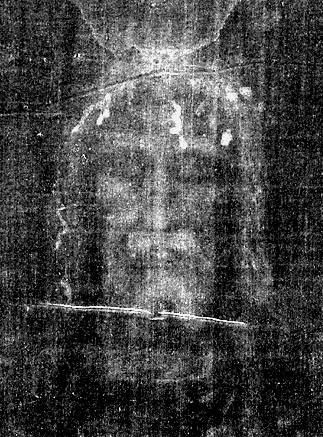
By now most people know something about the Shroud of Turin. And if you are reading "this" web page, you especially know. :-) However, there remain different opinions. Some insist it was indeed the cloth that covered the body of Christ when he was removed from the cross, while others insist it's a fake. More facts are needed.
First and from the point of view of the Shroud as a fake or intended replica by a trickster, one must note that the Shroud is in 3-D. This is a very important point, because even if it were a replica, such a replication would have been made long ago, as the Shroud has been scientifically proven to be extremely old. Even the nonbelievers accept this. Therefore, with our all of our advancement in technology, modern camera's only record light variations and intensities of reflected light, whereas the Shroud contains distance information within it. There is no camera or photograph having the ability to record distance from film to subject.
Add to that, if someone were to try to paint a replica, it would be literally impossible. An artist always steps back from their canvas to view what they are doing, if it's turning out as desired, etc. This means removing oneself by one - two meters for accuracy. Since the image on the Shroud is revealed by standing a significant distance, an artist would require a paint brush that was abnormally long (clumsy) AND the ability to hold it firm in order to paint very fine lines on cloth (not smooth canvas), as the Shroud contains distinct detail. Furthermore, 'album' has been scientifically proven in area's where scourge marks occurred, so our medieval trickster would need to include serum albumin as part of the paint, which only shows up under ultra-violet light, thus invisible paint. How would someone even know to include this invisible medium during an era where there were no ultra violet lights, no concern it might be 'checked' or examined for authenticity under such a light? What to speak of the lack of medical, anatomical knowledge at the time. The Shroud is completely, medically accurate. --- The list goes on.
Secondly, is it possible that, due to preconceived ideas that the person of the Shroud was all ready dead, most (though not all) scientists have a problem with how the Shroud image was created? Thus, their attachment to this belief has thrown off their data.
Thirdly, we can note that the markings on the Shroud correspond to specific descriptions in the Bible about the (horrendous!) beatings and persecution of Jesus Christ. I believe there is ample proof this is the Shroud of Christ. However, I wish to warn the reader that the evidence about to be presented may be verbally graphic, creating pictures within the mind of what this great Vaisnava, son of God, experienced. Upon my first read, it was difficult. (Though I reduced some of the gory details here.) For those of weak stomach, you can skip this part and still get a good idea via scientific facts that this Shroud belonged to Jesus simply by reading the following section, "BURST OF LIGHT - IS IT ASCENSION?" ......... With that said, I will now post some serious details. (You have been warned.)
When comparing the injuries left behind on the Shroud, it has an uncanny resemblance to those described in the Bible describing that which Jesus went through. What follows are summaries from examiners of STURP or "Shroud of Turin Research Project."
BLOWS TO THE FACE - The Shroud reveals swelling under the right eye, swelling on right cheek, etc. The same as Biblical descriptions of the soldiers abuses upon Christ, bludgeoning his face. (Correlates with: Matthew 27.30) ~ [Slightly below see: "Interesting Point About The Number 'Three' On Shroud's Face."]
WHIP - The person in the Shroud had over 29 wwhipp marks on the back and front of his body, some on the chest, but especially notable in the shoulder and back areas, indicating that this person was facing the column while being scourged. There are no marks on the forearms indicating that his arms were tied above him. The markings are characteristic of Roman flagrum - an instrument of torture, and it was a horrid instrument at that. Visible on the Shroud are approximately 60 strokes or 120 wounds, from scourging. (Correlates with: Matthew 27:26)
BLOODIED WHIP MARKINGS - At that time, one who was to be crucified had to carry their own cross to be crucified upon, causing the whippings to next become more bloodied. On the right shoulder of the Shroud there is blood from a wound of 10 x 9 cm. (Correlates with: Matthew.27:32)
BLOODIED FRONT and BACK of HEAD - There is blood on the head area of the Shroud, especially on the front and back of the head, thus thorns. Remember, not all who underwent crucifixion wore thorns. This was specially made for Christ - to humiliate him. (Correlates with: Matthew 27:29)
NAIL WOUNDS - While many think Christ had nails through his palms, it was later discovered he had them through his wrists. Makes sense, as nails through the hands would not be strong enough to hold one up and could cause ripping/breaking, then the person would fall off the cross. The Shroud has nail wounds (blood) spurting from the wrists area's. Three nails - one for each wrist and one nail through both feet - are blood stain evidence of the Shroud. (Correlates with: John 20:25)
KNEES & LEGS - Both knees have wounds (from carrying a ccross?); the right one is worse. (Jesus fell three times before he reached Calvary.) The Shroud also shows knee damage similar to that of falling - as one would have after going limp when removed from a cross. However, there were no injuries found on the upper or lower legs of the person in the Shroud; also according to the Bible there were no injuries to Christ's legs. Which, by the way, was unusual. More on that later. (Correlates with: John 19: 31-37)
HEART & RIGHT SIDE- A thin line on the shroud shows where blood from the nail wound in the right hand flowed along the right arm when the hand was un-nailed. Dead, dry blood does not run. Thus, another piece of evidence that Christ's heart was still active when he was lowered from the cross. In addition, the Shroud provides further proof where the lance the Roman soldier used to test Jesus as dead. Stains of blood show the lance pierced the right side of the chest between the fifth and sixth rib of the Shroud, with blood marking on the Shroud at an angle of twenty-nine degrees, revealing an oval wound like a sword or lance would make. This means that the lance passed close to the heart but did not damage it, thus the "blood and water" John describes that flowed from the wound could not have come from the heart. However slightly, the heart was still beating! Had the lance pierced the left side, it would have struck the heart. But through the right, it missed it. The Bible describes a lance put through the right side of Christ. (Correlates with: John 19:34)
The height of the person of the Shroud is 6 feet tall and he is of Jewish decent.
[INTERESTING POINT ABOUT THE NUMBER "THREE" ON SHROUD'S FACE - The STURP investigator's discovered the forehead held blood similar to that of the number "three." Chances of this happening in such a determined way and under such circumstances makes them wonder if it was mystical. Blood, which had been on the skin for a minimum of an hour, stayed fluid enough to be absorbed by cloth (Shroud). Unusual. Blood on skin congeals fifteen - twenty minutes, forming a hard, crust non-absorbable to cloth. Only due to heart activity can blood be pumped to the surface if there is no interference. While the continued flow of blood proves there was activity of the heart, why did it create this form they refer to as "number three?" Could it be an Aum on the face of he who is known as the "Anointed one?" What is also interesting, if someone wanted to apply to their face Om tilaka, essential oil, sandalwood paste, etc., this is the correct direction to put it. In other words, it's not backwards at all, and even appears to have the rest of the aum marking. To clarify, however, it's not that I am claiming this is definitely what it is. No. Merely that it is a worthwhile possibility most Christians will not allow examined. We know that Christ did, after all, live in India, as you will soon see.]
Did the person in the Shroud leave this world? When I was a child I remember asking my mother, "How do they know for sure when a person is dead?" I did not want anyone prematurely diagnosed, taken away or buried. She explained to me that a body is not always dead even if it has stopped breathing, so a doctor is called in to make sure.
We have all heard stories of people considered to be 'gone' because they stopped breathing, only to 'wake up' and shock everyone! Let us remember that at the time of the crucifixion, first century, many were not as knowledgeable about such things.
Even the average Joe or Jane knows more now than most did in the first century. For example, we all understand that a dead body does not bleed, that blood can not be released from wounds onto a cloth if the body is dead. But what about bleeding from the initial infliction of the wounds? Basically, it takes time to get someone down from a cross and into a cave. The wounds would have coagulated by than. Had Christ left his body completely, these stains would not have appeared on the Shroud. It is highly probably that Jesus survived, coupled with, his own disciples said his body was not capable of decaying.
When thorns around the head of a living being are removed, blood starts to spurt out. When thorns around the head of a dead person are removed, nothing comes out. Fresh blood is evidence that a heart is still pumping. However slight, it is still alive and doing it's job. Consider that blood cannot flow uphill without a pump, and the Shroud has blood stains in the head area, and a stream of blood flowed down each side of his forehead. Additionally, when a heart stops beating for a time, the veins somewhat constrict, making it even more difficult for blood to 'flow.'
Similarly, this would apply to the entire body -- a dead one would not leave any blood stains behind. The Shroud has many blood stains from different body area's. Nor does cloth take up and absorb dried, coagulated blood, but only that of fresh blood. A body not only tortured before the cross and on the cross, but even after, as taking him down resulted in pulling and stretching of various ligaments, muscles, and so on, resulted in reopening of wounds thus the bleeding started all over again. That is impossible from a dead body with no heart pump and therefore no blood pressure to push it through.
If this is not sufficiently convincing (thought it should be!), or if you are simply curious, you can get more details from STURP's website: https://www.shroud.com
"Behold my hands and my feet, that it is I myself: handle me and see; for a spirit hath not flesh and bones as you see me have." Luke 24:39
BURST OF LIGHT - IS IT ASCENSION?
Many claim that the existence of the Shroud is evidence that Jesus Christ did indeed ascend, releasing a burst of light and radiation which caused the image to be formed on the Shroud, and that this has not been scientifically explained away.
Others, though still believing this is the shroud of Jesus the Christ, simultaneously believe Jesus did not die on the cross, and that there is a scientific yet natural explanation regarding the making of the image on the Shroud. Matter of fact, the markings can also be evidence that Jesus survived the crucifixion!
This idea, of course -- a burst of light/ radiation is said to have released thermal neutrons which in turn caused the image. That is the theory. Some may feel let down to find out otherwise. But isn't truth better? Wouldn't it be fascinating to learn about the kind of life Jesus lived? He must have had so much more to teach! And how much more advanced knowledge we could learn! Obviously, I believe Christ lived, though I do not deny this anywhere on my web site at all. But I wanted significant proof.
The discover of Dr. Garza-Valdes reveals it is a scientific yet natural process that produced this image of Christ. Over the centuries there has been the development of a very thin coating that accumulated on the Shroud, the result of bacteria fungi build-up into hard casings. The darker areas on the image grew faster, and it was the darker areas that contained more natural deposits of these bioplastic coatings. Concentrations of “sweat, salt, oils, blood, and urea” would be higher in places of the Shroud that had touched his body, and lower in areas of the Shroud did not, thus pointing out that the image was made by “a relative deposit of bioplastic coating.” This coating had not been previously discovered due to its invisibility.
Also as a result, previous 'carbon dating' claims that the Shroud could not be Christ's because it was not quite old enough, has been proven incorrect. The carbon dating had been tested more-so on the (contaminated) coatings (hundreds of years old) and therefore not sufficiently on the Shroud cloth (thousands). Or rather, a mixture of the two, but not on the unaltered Shroud itself.
It does appear possible that Jesus could indeed have survived his ordeal of crucifixion with the Shroud as evidence that Jesus lived. Many believe essential oils, etc., were administered to Jesus within the cave (Jewish tradition is to wrap a dead body in a cloth or shroud, then lay them separate for three days). Though he came close to passing over, very close, he pulled out of it. After all, he was a healer himself! He raised the dead and healed the Lepers. Between that and the service that his disciples administered herbs and so on, it becomes believable that Jesus did not die on the cross.
It's also very feasible that he would not want to return to a land where people did such things to him! And to take advantage of the fact that many thought he was dead, thus he could move on to safer lands.
LEAVING THE SEPULCHRE
The resurrection is often a misunderstanding, or to be honest, what the church decided everyone must believe. To explain the details of how the Church has changed much of the Bible, including this, would take more space than I can give here. (See my first link, below.) Though it can be noted that some verses are bona fide while others are not. How do we know what is accurate? Generally, it is best to back it up with other evidence, such as that of science and various scriptures and books of the world, which has been done on this site and can be found elsewhere on the net. Therefore it is acceptable to use some Biblical verses which are in synch with science and the knowledge of others.
With that said, if any resurrection took place it would be that of such a pure soul to put up with, and survive such an ordeal, yet remain determined to preach! Some Christians fear it is an offense to even think Christ was not resurrected and did not ascend. This is not so. It would be more of an offense to deny all the great spiritual works he was facilitated to do through living after the crucifixion. After all, eventually he would pass over and go to God anyhow, he just did it later.
Now, the usual Jewish custom is to put the dead body into a grave and burry it as quickly as possible. This was not the case with Jesus. Instead he was laid in a spacious sepulchre. It provided sufficient air for breathing. Next, the entrance was blocked by a big rock. If Jesus wanted to leave the tomb, and was in the form of spirit, he could just float over it, above it, go through it, or take any other root out of the sepulchre. However, it has been made very clear that Jesus "moved" the stone. Only one who is alive would need to physically move the stone in order to exit the sepulchre.
"And [Joseph of Arimathaea] brought fine linen, and took [Jesus] down, and wrapped him in the linen, and laid him in a sepulchre which was hewn out of a rock, and rolled a stone unto the door of the sepulchre.
And Mary Magdalene and Mary the mother of Jesus beheld where he was laid.
And when the sabath was past, Mary Magdalene, and Mary the mother of Jesus, and Salome, had bought sweet spices, that they might come and anoint him.
And very early in the morning the first day of the week, they came unto the sepulchre at the rising of the sun.
And they said among themselves, Who Shall roll us away the stone from the door of the sepulchre?
And when they looked, they saw that the stone was rolled away: for it was very great.
And entering into the sepulchre, they saw a young man sitting on the right side, clothed in long white garment, and they were afright.
And he saith unto them, Be not afrightened; Ye seek Jesus of Nazareth, which was crucified; he is risen, he is not here, behold the place where they laid him.
But go your way, tell his disciples and Peter that he goeth before you into Galilee: there shall ye see him, as he said unto you." (Mark 15:46-7, 16:17-1)
The statement that the THREE women went into the tomb indicates how LARGE it must have been. Therefore, providing facility for Jesus to breathe and heal as well as receive visitors to apply herbs, etc., to his wounds.
Looking at John 19:9 we get an idea of the person who tended to the wounds of Christ just may have been Nicodemus.
"Joseph of Arimathaea, being a disciple of Jesus, but secretly for fear of the Jews, besought Pilate that he might take away the body of Jesus: and Pilate gave him leave. He came therefore, and took the body of Jesus.
And there came also Nicodemus, which at the first came to Jesus by night, and brought a mixture of myrrh and aloes, about an hundred pound weight." John 19.9
A hundred pounds of herbs? That certainly is more than could possibly pass for any Jewish burial custom. For that matter, there was no such custom. Then why a hundred pounds of herbs? To heal Christ's wounds, of course! And he did so with a special ointment. This has become a well known ointment called the Marham-I-Isa or the Jesus Ointment.
To continue:
"And if Christ be not risen, then is our preaching vain, and your faith is also vain. Yea, and we are fond false witness of God: because we have testified of God that he raised up Christ; whom he raised not up, if so be that the dead rise not." (I Corinthians 14: 14-15)
Therefore, it is understood Christ had not risen, unfortunately letting it effect their faith. However, one need not rise to prove purity. Thus, Jesus wounds had significantly improved and having left the sepulchre, he fled from his enemies and began the next step of his mission on earth.
Thus, when healed, Christ walked out of the sepulchre. He first met up with Mary Magdalene and her companion. They were on their way to inform his disciples that they had found Christ's tomb empty; that they had been told by an angel Jesus had risen and as on his way to Galilee: Yes, he rose, because he lived, he rose. As everything he did was spiritual.
"And they departed quickly from the sepulcher with fear and great joy; and did run to bring his disciples word. And as they went to tell his disciples, behold, Jesus met them, saying , All hail. And they came and held him by the feet and worshipped him.
Then said Jesus unto them, Be not afraid; go tell my brethern that they go into Galilee, and there shall they see me." Matthew 28:8-10
Notice the fear of the women, and Christ's endeavors to relieve them of this anxiety. It appears the ladies were frightened someone would discover Jesus.
Also notice Christ's plan to go on a sixty mile journey to Galilee. Although he sometimes would meet up with his disciples; he always made sure he was in a safe place and where they would not be noticed. All of this suggests that Jesus continued on not as spirit, but alive and that he took great pains to avoid discovery or or arrest.
Is there any more proof the Bible can offer us that Jesus survived the crucifixion, considering so few verses support this concept, probably due to human tampering? Well, they missed a few. One of the most clear verses is that of Luke 24: 36-9:
"And as they thus spake, Jesus himself stood in the midst of them, and saith unto them, Peace by unto you. But hey were terrified and affrighted, and supposed that they had seen a spirit. And he said unto them, Why are ye troubled and why do thoughts arise in your hearts? Behold my hands and feet that it is I myself; handle me, and see; for a spirit hath no flesh and bones, as ye see me have."
Dr. Herbert Haag's Bible Lexicon points out:
"Christ's visible ascent from the Mount of Olives, forty days after his resurrection, is related by Luke at the beginning of the Acts and summerized at the end of his gospel (Luke 24:51). It is not possible to consider the first of these accounts as a later interpolation, as some critics would like, for the literary structure of Acts 1:1-11 is entirely in accord with the theory that Luke wrote the whole work. Nor is it possible to argue that Acts 1:2 and Luke 14:51 should not contain any reference to the Ascension at all because the fact that certain manuscripts of the western family omit it seems to be owing to later omissions of the text. Therefore, it is Luke himself who is the source of both accounts, and who, after briefly mentioning the Ascension at the end of his gospel, goes on to tell us, at the beginning of Acts, that forty days elapsed between the Resurrection and the Ascension."
Look down two verses in Luke and you will discover that Jesus is hungry - spirit does not get hungry. The living get hungry.
And while they yet believed not for joy, and wondered, he said unto them, Have ye any met?
And they gave him a piece of broiled fish, and of a honeycomb,
And he took it and did eat before them.
[NOTE: he took "IT" singular. He did not take the meat because as the next verse explains, he accepted the good and refused the evil. This is better explained on my first web site, below.]
In John we read that Jesus showed his disciples his wounds and that he allowed Thomas to touch them:
"Then saith he to Thomas, Reach hither thy finger, and behold my hands; and reach hither thy hand, and thrust it into my side; and be not faithless but believing." John 20:27
Jesus walked out of the tomb, he rolled away the entrance rock himself, he ate honeycomb, made arrangements for his disciples to meet him in Galilee, showed wounds, and left that place in secret. Things a spirit does not do.
What some may find surprising is that the idea of Resurrection and Ascension did not originate from Christianity. When Jesus walked the earth it was a common pre-Christian belief. For anyone to be considered qualified as a great, saintly person, their life experiences had to duplicate that belief. Therefore, they generally had to be born of a virgin, in humble surroundings (a stable, prison cell, tiny room, cave, etc.), could heal, made it clear they came to preach and save souls, experienced temptation and passed the test, descended into hell only to rise out of it, there had to be some form of death or murder sent upon them to which they next had to prove their greatness through Resurrection and Ascension to God. These were requirements at that time if anyone was to be given qualified recognition as a savior. Thus, to try to "make" Christ fit as savior, this last bit was artificially tagged onto him, for the sake of 'preaching.' It is sad really, that they could not accept he was the savior without the requirement of such a young death leading to Resurrection and Ascension, but we can know this is not needed to prove anything. That Christ survived the crucifixion does not take away from his greatness one iota.
Eventually Jesus had to leave dangerous Palestine. However, he was not finished. He knew he still had his mission to fulfill. On to saving the lost children of Israel and, of all places, India!
DOCUMENTS OF CHRIST IN INDIA
Once I mentioned to a friend that Jesus traveled to many lands and his teachings were not limited to the Bible. She is a devotee of Lord Krishna and therefore open to this, but she asked the natural question most folks would. "Why didn't anyone see him?" My reply? "They did!" :-)
There were many eye-witnesses as well as those who personally spoke with Jesus, recorded; and many scrolls of his words. Simply, the information has been repressed.
First, let's look at Christ's presence at Jagannatha Puri, India where worship of Lord Jagannatha (Krishna) is number one. That Christ was there is not only documented in The Aquarian Gospel, but is also within the scripture known at the Hemis.
Christ's presence in India is additionally mentioned in the Bhavishya Purana, further described below. However, if more evidence is needed, there are other documents of proof that Jesus was, indeed, in India:
Bagh-i-Sulaiman (Persia)
Book of Balauhar and Budasaf (Buddhist)
Grugtha Thams Chand (Tibet)
Rauzat-us-Safa
Tarikh-i-Kashmir-i-Kabir
Tarikh-i-Kashmir
Wajees-ut-Tawarikh
Acta Thomae (Christian)
Ain-ul-Hayat
Bhavishya Purana (India)
Etc.
Why do we find it so shocking, so hard to believe, that Jesus visited many lands, as well as lived in India? Could this be due to the fact of our own indoctrination by Christians of the fundamentalists or conventionalists (and not all Christian) religion? They have a hard time accepting these facts about Christ and will do whatever they can to brush it under the rug. Nor can they imagine Jesus sitting in a meditation pose, or reading the Vedas! It shakes their faith. Yet true followers of Christ will not question his activities, even if they initially find them not what they had expected. The sincere will investigate and when they see the truth, as there is so much evidence that Christ did indeed live in India, the real Christians will accept.
And some do! However, it remains a sad reality that the average church-goer, and especially the fundamentalists, will never accept. Add to that the Roman Catholic Church and the Vatican, the many documents they keep under lock and key, sealed from the public so they can continue to propagate "their" idea of Christ as "the" idea -- thus we have all been conditioned to believe it too, in one way or another. Even the Hindus' and those of Jewish decent. For that matter, even the athiests.
Let us not buy into the myth. Christ was certainly able, and had facility, to travel and preach widely as well as settle down in India. Again, this is not said on a whim but based on documents as well as eye witnesses. One would think a Christian would be proud to own this aspect of Christ. Some are. They are called Essense's.
It is not that I necessarily agree that the Essense's have it cent per cent accurate, but they are the closest to it. At least they are respectful and do not refer to Hindus, Muslims or Jews as Heathens or Pagans.
Here's a look at just a few of the of the other documents about Jesus in various lands.
RAUZAT-us-SAFA
This is a historical Persian literature. It gives a wonderful description of Christ:
“Jesus (on whom be peace) was named the “Messiah” because he was a great traveler. He wore a woolen scarf on his head and a woolen cloak on his body. He had a stick in his hand; he used to wander from country to country and from city to city. At nightfall he would stay where he was. He ate jungle vegetables, drank jungle water, and went on his travels on foot. His companions, in one of his travels, once bought a horse for him; he rode the horse one day, but as he could not make any provision for the feeding of the horse, he returned it. Journeying from his country, he arrived at Nasibain. With him were a few of his disciples whom he sent into the city to preach. In the city, however, there were current wrong and unfounded rumors about Jesus (on whom be peace) and his mother. The governor of the city, therefore, arrested the disciples and then summoned Jesus. Jesus miraculously healed some persons and exhibited other miracles. The king of the territory of Nasibain, therefore, with all his armies and his people, became a follower of his. The legend of the ‘coming down of food’ contained in the Holy Quran belongs to the days of his travels.”
BOOK of BALAUHAR and BUDASAF
This is a Buddhist book. The name Yuz Asaf is the same Lord Jesus Christ. Jesus was considered to have Buddhist-like enlightenment by them and so you may notice his name for this place of his preaching is similar to Bud-Asaf. According to Bhagavad-gita, the pure devotee preaches according to time, place and circumstances. In this way people are gradually elevated without much irritation to the mind.
The reader will notice the various names used by Christ. It appears he accepted a name according to his position and in accordance to the country he was preaching in. Certainly this would help the people relate better. What is most interesting is that the names he preferred and kept have roots in the more ancient languages, Hebrew (he was, after all, meant to be the savior of the Jews), and Sanskrit (he also was a Vaisnava - a devotee of Krishna.) And so we see that whenever he had the opportunity to use or add the name "Isa" (pronounced Isha), which Bhagavad-gita defines as "God" or the "Supreme Being," he chose that name. Though we also need to note that he included various additives to show he was the "servant" of God, such as Isa-Messiah, which is similar to Isa-das (servant of Isa/God). Now sometimes he used other additives, also according to time, place and circumstance. But these were his favorites.
ISLAM AND CHRIST
Many may be surprised to learn that followers of the Muslim religion are believers in Jesus Christ. There are some differences, but much is alike. For example, it is believed Jesus is son of God, left this world on the cross, and there will be a second coming where he will reestablish the original faith - Islam.
Just for the record, Allah is not a name of God, but the word "God." If you were to look this up in an Arabic-to-English dictionary, that would be the only way to find a listing for the word "God."
Next, the (basic) differences are that God made a switch at the crucifixion, pulling Judas into the place of Christ, and raising Christ to the heavens directly from the cross. Of course, there are many other differences as well.
The question arises, "How did those of Muslim decent learn of Jesus?" Because he traveled there too, preached there too. His actual presence is logged in their scripture.
The Holy Quran is their first book and of utmost importance (which includes mention of Jesus), followed by Sunnah or as we understand it, Saddhana (spiritual practice). Then, the Hadith, second book, a book of sayings by Muhammad where he also mentions Jesus Christ. Thus it appears the distaste some Muslims have toward Christians is not about Christ at all, but toward fundamental Christianity.
In the Muslim religion, the first prophet of importance is Mohamed, and next is Jesus Christ, who they sometimes refer to as "Imam Mahdi." Others claim they are two separate personalities, though it appears the general consensus is that it's Jesus. Ultimately it doesn't matter in one sense, as the Muslim belief is that both are suppose to come again and restore true religiosity.
There are many verses giving reference to Christ. Since the Muslims are also in a debate regarding whether Christ lived or not after the Crucifixion, I am not here to show what their scriptures reveal. I only wish to show that Jesus is mentioned within their scripture and he therefore traveled through their country. I will just put some verses here, as there are quite a few.
“Behold! God said: ‘O Jesus! I will take thee and raise thee to Myself and clear thee of the falsehoods of those who blaspheme; I will make those who follow thee superior to those who reject faith, to the day of Resurrection. Then shall ye all return unto me, and I will judge between you of the matters wherein ye dispute.” 1 (Quran, Chapter 3, v. 54 -- Yusuf Ali English translation)
“And because of their saying (in boast) ‘We killed Messiah Isa (Jesus) son of Maryam (Mary), the Messenger of Allah,’ but they killed him not, nor crucified him. But the resemblance of Isa (Jesus) was put over another man (and they killed that man)” (Hilali & Khan translation)
From the Hadith: “What will be your reaction when the son of Mary (Jesus) descends and your Imam [leader] is from among yourselves?”
Srila Prabhupada was a child at a time when Hindus and Muslims lived side by side in peace, with mutual respect for each others religion. It was not until the invasion of the British and a scheme by them, that problems arose. (Though let us remember this was the British of another mentality. And a devotee in England is, after all, a devotee! Thus not under such bodily concepts.) As a child, Prabhupada lived close enough that he would hear the bells of the Mosque ring and his father, also a pure devotee, would make nice comments about them.
" 'You can chant the name of Allah also. Not necessarily that you have to chant the Krsna name, but any name indicating the Supreme Lord can be chanted.' Because in the sastra it is said, harer nama, harer nama, the holy name of the Lord. But it must be the name of the Lord. Actually, Krsna has thousands of names, and His names are enumerated by His activities. Just like Krsna accepted to become the son of mother Yasoda; therefore He is called Yasoda-nandana. Krsna accepted Vasudeva as His father, or Nanda Maharaja; therefore He is called Nanda-nandana, Vasudeva, or Devaki-nandana. Krsna acted as the charioteer of Arjuna; He is called Partha-sarathi. So Krsna's name means attached with the activities along with His devotees. This is Krsna's name. So if the Muhammadans' aim the Supreme Lord, Allah akbar, "God the great..." Just like we say Parabrahma. Brahman means the biggest, brhatvat brhannatvat. On account of being very big, including everything, that God's another name is Parabrahma. Param brahma param dhama pavitram paramam bhavan. Arjuna addressed Krsna as Parabrahma. So Allah akbar means Parabrahma." ~ Srila Prabhupada Arrival Lecture, Calcutta India, March 20, 75
If everything you have read so far on my web site is not convincing enough (again, it should be!), or if you are just curious, you can google for details with keywords Tomb Of Jesus.
BUDDHISM & JESUS CHRIST
Much of the overall information on Jesus and his experiences with Buddhism have been covered on my previous web page, Christ and Krishna (see link below). However, since the topic of this particular site is also about the wide traveling of Jesus, more is included here.
And so we can start with Nicholas Notovitch and his discovery of documents that gave reference to the same Lord Jesus Christ he had worshiped in church. What makes his discovery of the Isa (Jesus) documents so potent is that he was not out to promote any religion and for that matter, he merely "bumped into" them!
While in India, Notovitch rode by horseback to a Buddhist monastery (a place called Mulbek near the Wakha River) where he met a monk. In casual conversation this monk informed him they too believe in the son of God, Jesus, whom they call Isa, and that there are documents/scrolls of Isa's spoken word written down in Tibet. THIS is what spurred Notovitch's curiosity, thus he had to ask exactly where these documents were to be found. Now, he had initially planned on returning to Europe, so we can again see he was not on this trip to prove any religious faith. It was only upon hearing this from the monk that Notovoch next postponed his return, in order to see if he could get a look at the documents himself. Which he did.
Some claim Notovitch was never there and the scrolls are a fabrication. First let us point out that in later years Swami Abhedenanda, having heard about such discoveries, traveled to this same Monastery and there he found the documents, which he too had translated. What's interesting is how his translations are so much alike as those of Notovitch. Thus they are obviously the same documents. Yet skeptics or those who fear this will hurt their religion, still disbelieve.
In time a Catholic priest visited. He asked the monks if he could borrow the Isa documents, to which these innocent monks gave permission. Needless to say, the priest stole them, and now it "appears" they were never there. Did he keep them personally? Are they in the Vatican? Did he destroy this jewel? We may never know. Regardless, if the endeavor was to wipe out any scripture about Jesus other than their own, it would never work since there is plenty of documentation of the preaching of Christ in many countries. And some say there is still documentation of Christ in Tibet, but in most cases the monks will not allow others access to them. They don't want anything else stolen! However, Notovitch was not the only person to view the Hemis documents. A significant number of others have seen them too.
With that said and returning to Notovitch, while on horseback near the Hemis Monastery, he broke his leg. Therefore Buddhists monks took care of him as well as brought to his bedside, the Isa documents, with a translator, and Notovitch took notes! Many of which can be found on my first web page as well as the Aquarian Gospel, above. From his book, "The Unknown Life Of Jesus Christ"' here are a few of his notes:
"It was then that Issa clandestinely left his father's house, went out of Jerusalem, and, in company with some merchants, traveled toward Sindh, that he might perfect himself in the divine word and study the laws of the great Buddhas. In the course of his fourteenth year, young Issa, blessed by God, journeyed beyond the Sindh and settled among the Aryas in the beloved country of God. The fame of his name spread along the Northern Sindh. When he passed through the country of the five rivers and the Radjipoutan, the worshippers of the God Djaine (Buddhism) begged him to remain in their midst.
"But he left the misguided admirers of Djaine and visited Juggernaut, in the province of Orsis, where the remains of Viassa-Krichna rest, and where he received a joyous welcome from the white priests of Brahma.
"They taught him to read and understand the Vedas, to heal by prayer, to teach and explain the Holy Scripture, to cast out evil spirits from the body of man and give him back human semblance. He spent six years in Juggarnaut, Rajegriha, Benares, and the other holy cities; all loved him, for Issa lived in peace with the Vaisyas and the Soudras, to whom he taught the Holy Scripture.
As explained, Jesus was not found of the kali-yuga caste system and preached strongly against it:
"For on the day of the Last Judgment, the Soudras and the Vaisyas shall be forgiven because of their ignorance, while God shall visit his wrath on them that have arrogated his rights.' The Unknown Life of Jesus, N. Notovitch.
Good point! :) Anyway, Jesus had to move on, though later to return to India. But first he traveled to Gothamide where he learned the Pali language and studied Buddhist literature. It can be discovered that many of the Biblical quotes and parables from Jesus had much in common with Buddhism, incredibly so. Many Christians feel threatened by this, but there really is no need to. We often forget, the guru is smarter then we are. :-) Thus, Jesus was perfectly capable of extracting what he found agreeable and accurate from Buddhist teachings without accepting their ideas of no God or at best, a void One. Yet Jesus was always respectful. Though as you will read in my 2nd link 'Christ and Krishna' on the Aquarian Gospel, there were some very definite concepts of Buddhism Jesus argued. With that said, I hope I have dispelled any fears or just concerns about similarities between Christ, the Bible and Buddhism. It's nothing to worry about.
Therefore, let's take a look at just a few of those similarities, which one can't help but wonder, if there are more (and there are!), Jesus must have studied Buddhist doctrines. Being wise, he 'dovetailed' what he learned from them into Bhakti Yoga, or in Christian terminology, love & devotion to God. Step number one of any spiritual realization process requires getting off the bodily concept of life and then one can connect to spiritual life.
"Shame on you Pharisees! For you clean the outside of the cup and the dish, but inside you are full of greed and incontinence. Foolish Pharisees! Clean the inside and the outside will also be clean. Shame on you Pharisees! For you love the front seats in the assemblies and greetings in the marketplaces. Shame on you! For you are like graves, outwardly beautiful, but full of pollution inside."
"What is the use of your matted hair, O witless man? What is the use of your antelope skin garment? Within, you are full of passions; without, you embellish yourself." (Dh 26:394).
"No man can serve two masters. Either he hates the one and loves the other, or he is loyal to one and despises the other. You cannot serve God and wealth [mammon]"
"Surely, the path that leads to worldly gain in one, and the path that leads to Nibbana is another; understanding this, the Bhikkhu, the disciple of the Buddha, should not rejoice in worldly favors, but cultivate detachment." (Dh 5:75)
"Because of that I say this: Whoever is emptied will be filled with light; but whoever is divided will be filled with darkness."
"A wise man renounces evil and sensual pleasure and he does all meritorious work in order to attain Nibbana. He becomes a homeless one" (Dh 6:87)
"He who wishes to follow me must know himself and bear my yoke."
"The Bhikkhu who, while still young, devotes himself to the Buddha's Teaching, illuminates this world like the moon freed from a cloud" (Dh 25:382)
Now, wherever Jesus traveled to, regardless of country, he continued to preach equal rights and defend people who were being repressed. He had equal vision. Bhagavad-gita describes one of equal vision as saintly.
Unfortunately most of the priests of the world, in nearly every country he visited, did not have this equal vision. Therefore Jesus quarreled with all of them, thus many ran him off. He was often humiliated as well as put himself in harms way, yet he continued to preach his belief: (aham brahmasmi) you are not your body/caste but pure spirit soul, there is only One God & He is personal, pray/chant or sing His glories!
And so in time, Jesus took his people to the Promised Land where even he settled down. Well, he moved there, but he never quieted down. And we are glad for that.
Related LINKS:
Christ & Krishna BlogPost Part_1: 1st of my 3 web pages of research from years back, happy to find them! Topics on this one: Byzantine paintings of Jesus, Tilaka markings, the Lost Years of Jesus info via Notovitch, etc!
Christ & Krishna Part_1B: Expansions Of The Basic Tenets Of Christianity to Krishna Consciousness [Some words in the Bible and their original meaning], Vegetarianism in the Bible, Prabhupada talks with Priests, More!
Christ and Krishna Pt 2 - Excerpts from Aquarian Gospel of Jesus the Christ Excerpts - with my Krishna C understanding to take or leave, followed by various quotes from Srila Prabhupada on Jesus.
Christ and Krishna: Former post on this blog on the topic before I found my web pages.
With all that's going on in the world at this time, and some people preparing to cook Christmas Dinner, here is a link - not with recipes exactly - but idea's in general to cook at a cheaper cost, along with other help for our times.